
Many students believe that choosing a career is simply about selecting the stream with the highest marks, following a passion, or pursuing a popular profession. While these factors may influence a decision, they rarely provide enough clarity to make an informed choice.
Today, students have access to more career options than ever before. Along with traditional fields, new industries and roles continue to emerge, making career decisions increasingly complex. At the same time, students often receive advice from parents, teachers, friends, and social media much of it conflicting.
As a result, feeling uncertain about the future is more common than many people realize. In most cases, the challenge is not a lack of ambition but a lack of understanding about how personal strengths, interests, and opportunities fit together.
This is one of the main reasons why career counselling is important for students. It helps students understand themselves better, explore suitable career paths, and make informed academic and career decisions.
In this article, we’ll explore why career decisions have become more challenging, what career counselling actually involves, and how it can help students move forward with greater clarity and confidence.
Why Students Feel More Confused About Careers Today
Students are often told that they need to “find their passion” or “decide what they want to become.” The reality is that career decisions have become far more complex than they were for previous generations.
More Career Options Than Previous Generations
A few decades ago, students were generally aware of a limited number of career paths. Today, alongside fields like engineering, medicine, and law, students can explore opportunities in areas such as data science, digital marketing, UX design, artificial intelligence, psychology, sustainability, and many others.
While having more choices is positive, it also makes career planning more challenging. Students are expected to evaluate a growing number of options, often without enough exposure to understand them properly.
Information Overload and Conflicting Advice
Students have access to more information than ever before. A simple online search can generate hundreds of articles, videos, and opinions about careers and education.
The challenge is that not all advice is relevant or accurate. Different sources often recommend different paths, making it difficult for students to distinguish useful guidance from general opinions and trends.
Pressure From Parents, Peers, and Social Media
Career decisions are rarely influenced by students alone. Parents may prioritize stability, peers may follow popular choices, and social media often highlights only the success stories behind certain careers.
As a result, students may feel pressure to make decisions based on expectations rather than their own interests, strengths, and long-term goals.
Rising Career Uncertainty Among Students
Career uncertainty is becoming increasingly common. According to OECD research, around 40% of students report uncertainty about their future careers.
This does not mean students lack ambition. In many cases, it reflects a lack of career awareness, limited exposure to different professions, and uncertainty about how education choices connect to future career options.
What Career Counselling Actually Does
One of the biggest misconceptions I come across is that career counselling is supposed to tell students exactly what they should become. Students often walk into a counselling session hoping to hear a single answer—a career that is guaranteed to be the right fit.
In reality, that’s not how good career counselling works.
The purpose of career counselling for students is not to predict the future. It is to help students understand themselves better, explore their options thoughtfully, and make decisions with greater clarity and confidence.
Understanding Strengths, Interests, and Aptitudes
A career decision becomes much easier when students have a realistic understanding of their strengths, interests, and natural abilities. Yet this is often the part that gets overlooked.
Through discussions, reflection exercises, and sometimes a psychometric assessment, students gain insights into how they think, learn, and work. These insights don’t determine a career, but they can provide useful direction.
Exploring Career Options Beyond Familiar Choices
I’ve often noticed that students limit themselves to careers they already know about. If someone has never been exposed to a profession, it’s unlikely they’ll consider it as a serious option.
This is where career exploration becomes valuable. It helps students look beyond familiar choices and discover opportunities they may not have considered before.
Connecting Education Decisions With Career Goals
Students are frequently asked to choose subjects, streams, courses, or colleges without fully understanding how those decisions connect to future opportunities.
Career counselling helps bridge that gap. It allows students to see how today’s educational choices can influence tomorrow’s career possibilities.
Creating a Structured Decision-Making Process
At its core, career counselling is about improving decision-making. Instead of relying on assumptions, trends, or outside pressure, students learn how to evaluate options more objectively.
The goal is not to find the perfect career. The goal is to make well-informed decisions based on self-awareness, exploration, and a clearer understanding of the opportunities ahead.
Why Career Counselling Is Important for Students
When students think about career counselling, they often expect it to provide answers. In practice, its real value lies in helping students ask the right questions, evaluate their options carefully, and make decisions they can stand behind.
That is one of the main reasons why career counselling is important for students. It doesn’t remove uncertainty entirely, but it helps students navigate it more effectively.
It Helps Students Understand Themselves Better
One of the most common challenges students face is understanding what genuinely suits them. Academic performance alone rarely provides the full picture.
Through guided discussions and assessments, students gain a clearer understanding of their strengths, interests, learning preferences, and working styles. This self-awareness creates a stronger foundation for future career decisions.
It Expands Awareness of Career Opportunities
I’ve often seen students limit their choices to careers they already know about through family, school, or social circles. The problem is that awareness and opportunity are not always the same thing.
Career counselling introduces students to a wider range of traditional and emerging careers, helping them understand different career pathways and the skills required for each. This broader perspective allows students to explore options they may not have considered on their own.
It Supports Better Academic Decisions
Students are required to make important academic choices long before entering the workforce. Decisions related to stream selection, subject combinations, courses, and colleges can influence future opportunities in significant ways.
Career guidance for students helps connect these educational decisions with long-term goals. Instead of choosing based solely on popularity or outside opinions, students can evaluate options with greater context and purpose.
It Reduces Career Confusion
Confusion often comes from having too many options and too little clarity. Students may find themselves interested in several careers but unsure how to compare them or decide between them.
Career counselling provides a structured framework for career decision making. It helps students organize their thoughts, identify priorities, and assess options more objectively rather than relying on assumptions or guesswork.
It Builds Confidence in Career Decisions
One of the less discussed benefits of career counselling is the confidence that comes from making informed choices. Students may still face uncertainty, but they are more likely to understand why they are making a particular decision.
This sense of ownership is important. When students understand themselves, explore their options, and evaluate decisions carefully, they become more confident in the path they choose and more prepared to adapt as their goals evolve.
What Most Advice Gets Wrong About Career Counselling
Career counselling can be valuable, but it’s important to understand what it can and cannot do. Over the years, I’ve noticed a few misconceptions that often create unrealistic expectations and lead students in the wrong direction.
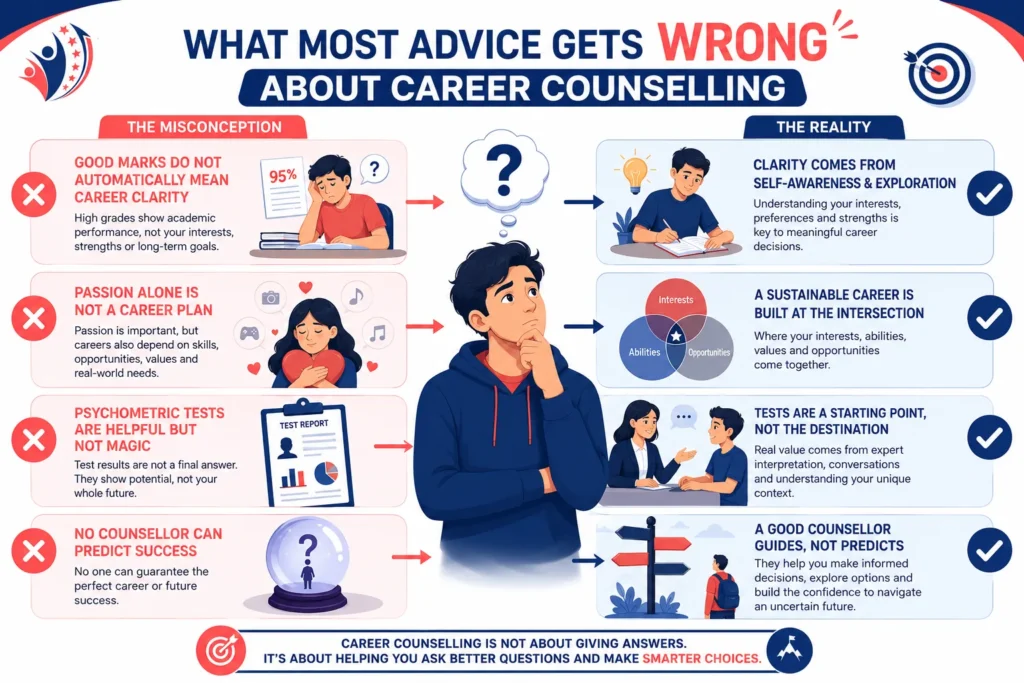
Good Marks Do Not Automatically Mean Career Clarity
A student may perform exceptionally well in school and still feel uncertain about the future. Academic success reflects performance in specific subjects, but it doesn’t always reveal interests, preferences, or long-term career aspirations.
That is why some high-achieving students continue to struggle with career decisions despite having excellent grades.
Passion Alone Is Not a Career Plan
Students are often encouraged to “follow their passion.” While interests matter, career decisions also involve skills, opportunities, values, and practical considerations.
A sustainable career is usually built where interests, abilities, and opportunities intersect—not on passion alone.
Psychometric Tests Are Helpful but Not Magic
Psychometric assessments can provide useful insights into strengths, interests, and personality traits. However, a test report should be viewed as a starting point, not a final answer.
The value comes from interpreting those insights within the student’s unique circumstances, goals, and aspirations.
No Counsellor Can Predict Success
One of the biggest myths about career counselling is that a counsellor can identify the perfect career or guarantee future success.
The reality is that no one can predict exactly how a student’s career will unfold. A good counsellor helps students make informed decisions, understand their options, and navigate uncertainty with greater confidence. That is very different from predicting the future.
What Actually Matters Instead
When students think about career decisions, they often look for certainty. They want to know which stream, course, or profession will guarantee success. The problem is that careers rarely work that way.
What matters more is developing the ability to make thoughtful decisions based on the information available today. As students gain new experiences and opportunities, their understanding of themselves and their goals often evolves as well.
This is why self-awareness is so important. Students who understand their strengths, interests, values, and preferences are better equipped to evaluate opportunities and make choices that align with who they are.
Equally important is exploration. Career decisions should not be based solely on assumptions or limited exposure. Exploring different industries, roles, and pathways helps students develop a more realistic understanding of their options.
Good career decisions are rarely the result of perfect predictions. They come from informed decision-making, continuous learning, and a willingness to adapt as circumstances change.
In the end, students do not need absolute certainty about the future. They need enough clarity to take the next step with confidence and enough adaptability to navigate the opportunities and challenges that follow.
When Should Students Consider Career Counselling?
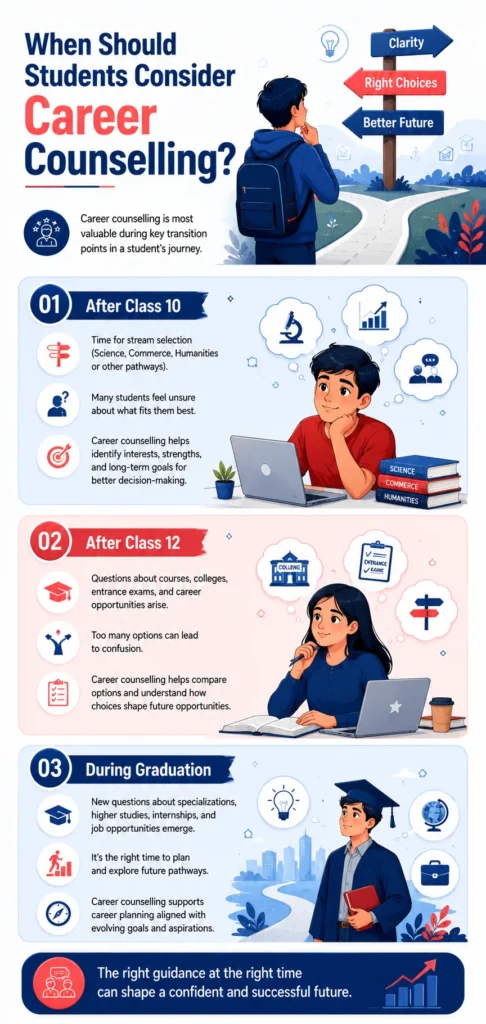
There is no single age or stage at which career counselling becomes necessary. However, it can be particularly valuable during key transition points when students are required to make important academic or career decisions.
After Class 10
One of the most common reasons students seek career counselling after 10th is stream selection. Choosing between Science, Commerce, Humanities, or other pathways can feel overwhelming, especially when students are unsure how these choices connect to future careers.
Career counselling can help students evaluate their interests, strengths, and long-term goals before making this decision.
After Class 12
The period after school often brings questions about courses, colleges, entrance exams, and career opportunities. With hundreds of options available, it is easy to feel uncertain about the best path forward.
Career counselling after 12th helps students compare options more systematically and understand how different educational choices may influence future opportunities.
During Graduation
Career decisions do not end once a student enters college. Questions about specializations, higher education, internships, and job opportunities often emerge during graduation.
At this stage, career counselling can support career planning by helping students assess their options, identify suitable pathways, and make decisions that align with their evolving goals and aspirations.
In Essence
Choosing a career has never been about finding a single perfect path. Today’s students are expected to make important decisions in a world filled with opportunities, information, and uncertainty. That can be overwhelming, but it also makes informed decision-making more important than ever.
Career counselling is valuable because it helps students understand themselves better, explore possibilities they may not have considered, and connect their educational choices with long-term goals. Its purpose is not to predict the future but to provide clarity where confusion often exists.
The students who make the strongest career decisions are not necessarily those who have all the answers. They are the ones who take the time to understand themselves, explore their options, and move forward with purpose. In the end, the goal is not certainty about every step ahead—it is having enough clarity to take the next one with confidence.