
For many students, Class 10 feels like the point where they are expected to make a decision that will shape the rest of their lives. Questions about streams, careers, future opportunities, and job security suddenly become part of everyday conversations. At the same time, advice starts coming from all directions—parents, relatives, teachers, friends, and increasingly, social media. While most of it is well-intentioned, it often leaves students feeling more confused than confident.
One of the biggest misconceptions around stream selection is the belief that choosing the wrong stream after 10th will permanently damage your future. This creates unnecessary pressure. In reality, while the decision is important, it is not a one-time choice that determines everything that follows. Career paths today are far more flexible than many people assume, and successful careers are often built through exploration, learning, and adjustment over time.
The real challenge is not deciding your entire future at the age of 15 or 16. It is making a thoughtful and informed decision about the next stage of your education. That requires more than looking at marks, following trends, or copying what others are doing. It requires understanding your strengths, interests, learning preferences, and the opportunities available to you.
If you are wondering how to choose the right career path after 10th, this guide will help you think about the decision more clearly, avoid common mistakes, and build a practical framework for choosing a path that fits you not just what everyone else expects.
Why Choosing a Career Path After 10th Feels So Difficult
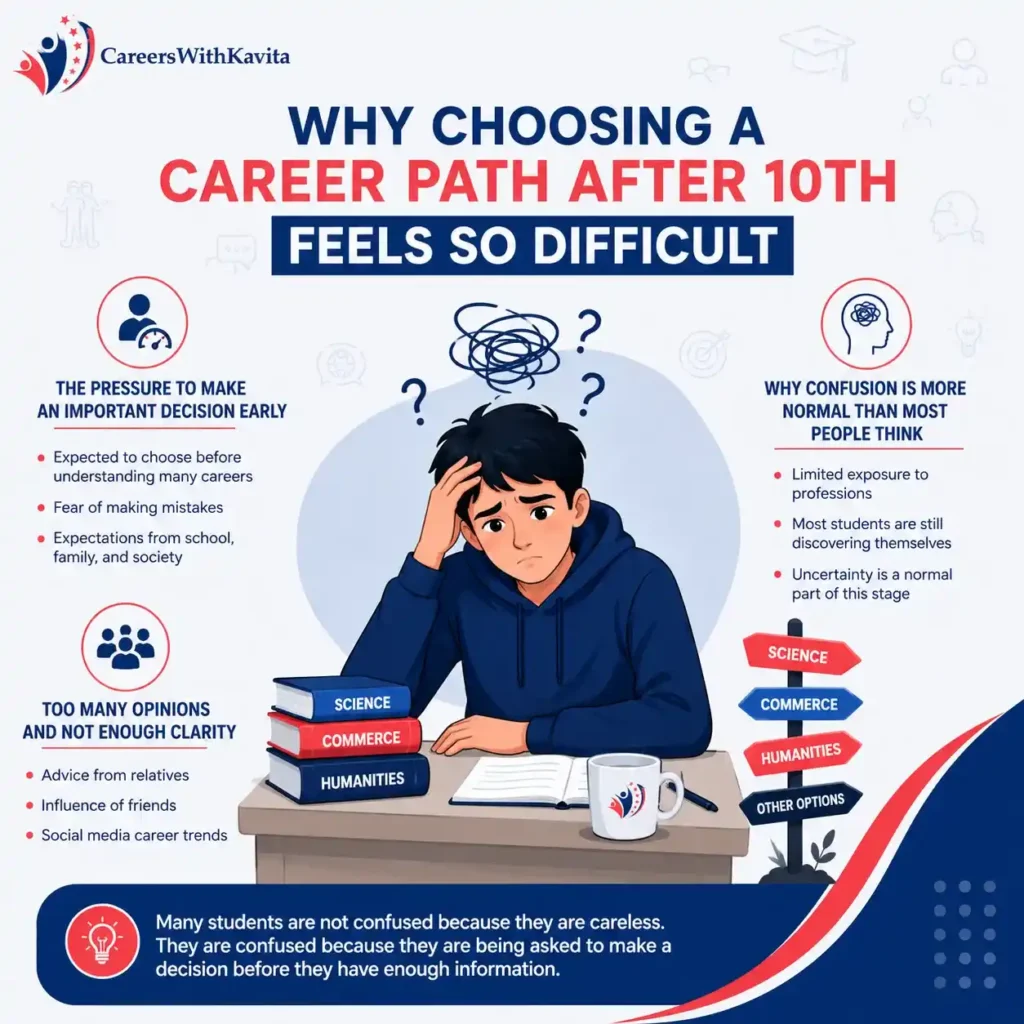
The Pressure to Make an Important Decision Early
One of the biggest challenges students face after Class 10 is being asked to make a major educational decision before they fully understand the career paths available to them. At 15 or 16 years old, most students have had limited exposure to the professional world, yet they are expected to choose a stream that could influence their future academic direction.
This often creates a fear of making the wrong choice. Alongside that, expectations from schools, families, and society can make the decision feel even more significant than it actually is.
Too Many Opinions and Not Enough Clarity
When it comes to stream selection, advice is rarely in short supply. Parents want what they believe is best, relatives share their experiences, friends influence each other’s decisions, and social media constantly promotes trending careers and success stories.
The problem is that much of this advice is based on someone else’s circumstances, strengths, or perceptions. What worked for one person may not necessarily be the right fit for another. As a result, students often end up with more opinions than actual clarity.
Why Confusion Is More Normal Than Most People Think
Many students assume that being unsure means they are behind others. In reality, uncertainty is a normal part of this stage. Most students are still discovering their interests, strengths, and learning preferences. They simply have not had enough exposure to different professions to make an effortless decision.
This is why effective career guidance after 10th focuses on helping students understand themselves and explore options rather than rushing them toward a quick answer. Many students are not confused because they are careless. They are confused because they are being asked to make a decision before they have enough information. Understanding that can remove a lot of unnecessary pressure from the process.
What Most Advice Gets Wrong About Stream Selection After 10th
When students start exploring which stream to choose after 10th, they are often given advice that sounds logical on the surface but does not always lead to the right decision. The problem is not a lack of advice—it’s the quality of the advice.
Choosing Based Only on Marks
A common belief is that marks should determine the stream. While academic performance can indicate strengths in certain subjects, it does not automatically reveal what kind of work a student will enjoy or excel at in the long run.
A student may score well in Science and still find greater satisfaction and success in Commerce, Humanities, or another path. Marks are one input, not the entire answer.
Treating Science as the Default Option
In many households, Science is often viewed as the safest or most prestigious choice, especially for students with high scores. The reality is that Science does create many opportunities, but opportunity and suitability are not the same thing.
A stream only becomes valuable when it aligns with a student’s interests, abilities, and goals. Choosing Science simply because it is considered the “best” option can lead to frustration if it is not the right fit.
Following What Everyone Else Is Doing
Friends often influence stream selection after 10th, especially when students are uncertain. However, different people have different strengths, interests, and ambitions.
A path that works well for one student may not work equally well for another. Career decisions should be personal, not social.
Focusing Only on Future Salary
Salary is important, but making decisions based solely on earning potential can be misleading. Industries change, new careers emerge, and labour market demands evolve over time.
Instead of chasing a salary figure, students should focus on building skills and choosing a path they can genuinely commit to and grow within.
Ultimately, a stream should not be chosen because it is popular. It should be chosen because it fits the student. The goal is not to follow the crowd—it is to make a decision that makes sense for your own future.
What Actually Matters Instead
If marks, trends, and outside opinions should not be the primary factors behind stream selection, then what should students focus on instead? Effective student career planning usually comes down to balancing three key factors: interests, strengths, and future opportunities.
Interests
Interests are often the starting point because they influence motivation and engagement. Think about the subjects, activities, or topics that naturally hold your attention. These are usually the areas where learning feels less like a task and more like something you genuinely want to explore.
However, it is important to distinguish between long-term interest and temporary excitement. Watching a few videos about a career or finding a topic interesting for a week is not the same as having a sustained interest in it. The goal is to identify patterns that have remained consistent over time.
Strengths
Interests alone are not enough. Students should also consider their strengths. These include subjects where they consistently perform well, skills that come naturally, and the ways they learn best.
For example, a student may enjoy creative work but also have strong analytical abilities. Another may excel at communication, problem-solving, or working with people. Understanding these strengths can provide valuable clues about suitable academic and career paths.
Future Opportunities
Career decisions should also account for future possibilities. This does not mean chasing trends or predicting the highest-paying job. Instead, it means understanding the career scope, growth potential, and flexibility associated with different pathways.
A good choice should not only fit who you are today but also provide room for growth and exploration in the future.
Why Balance Matters More Than Any Single Factor
Many students make decisions by focusing on just one factor. Choosing a stream only because it interests you can be risky if it ignores your strengths. Choosing only for salary may lead to a path you struggle to stay committed to. Choosing solely based on marks can overlook what genuinely motivates you.
The strongest career decisions happen when interests, strengths, and opportunities point in the same direction. That balance rarely guarantees certainty, but it does create a much stronger foundation for making informed decisions and seeking meaningful career guidance after 10th.
Understanding the Major Career Pathways After 10th
When discussing science, commerce, arts after 10th, many students immediately start looking for the “best” stream. A better approach is to understand what each pathway offers and who it tends to suit. No stream is inherently better than another different streams serve different goals, interests, and strengths.
Science Stream
Science is often a good fit for students who enjoy subjects such as Mathematics, Physics, Chemistry, or Biology and are comfortable with analytical and problem-solving work. It can lead to a wide range of career options after 10th, including engineering, medicine, research, data science, architecture, and several interdisciplinary fields.
One common misunderstanding is that Science is the only stream with strong career prospects. While it does provide access to many opportunities, success still depends on a student’s interest, aptitude, and commitment.
Commerce Stream
Commerce is generally well-suited for students interested in business, finance, economics, accounting, and entrepreneurship. It can lead to careers in fields such as accounting, banking, financial analysis, management, law, and business consulting.
A common misconception is that Commerce is only for students who do not choose Science. In reality, it offers specialized career paths and professional qualifications that require their own set of skills and strengths.
Humanities Stream
Humanities is often ideal for students who are interested in understanding people, society, communication, history, politics, psychology, or creative disciplines. It can lead to careers in law, public policy, journalism, psychology, design, education, civil services, and many other fields.
One of the biggest myths surrounding Humanities is that it has limited scope. In practice, many leadership, policy, research, and communication-oriented careers emerge from this stream.
Vocational and Skill-Based Options
Not every student needs to follow a traditional academic route. Vocational and skill-based programs are becoming increasingly relevant as industries seek practical, job-ready skills. Fields such as digital marketing, graphic design, hospitality, healthcare support, information technology, and technical trades offer viable career pathways.
The key takeaway is simple: successful careers are built through alignment, not hierarchy. The right stream is not the one with the highest status—it is the one that matches your abilities, interests, and long-term goals.
A Practical Framework for Choosing the Right Stream
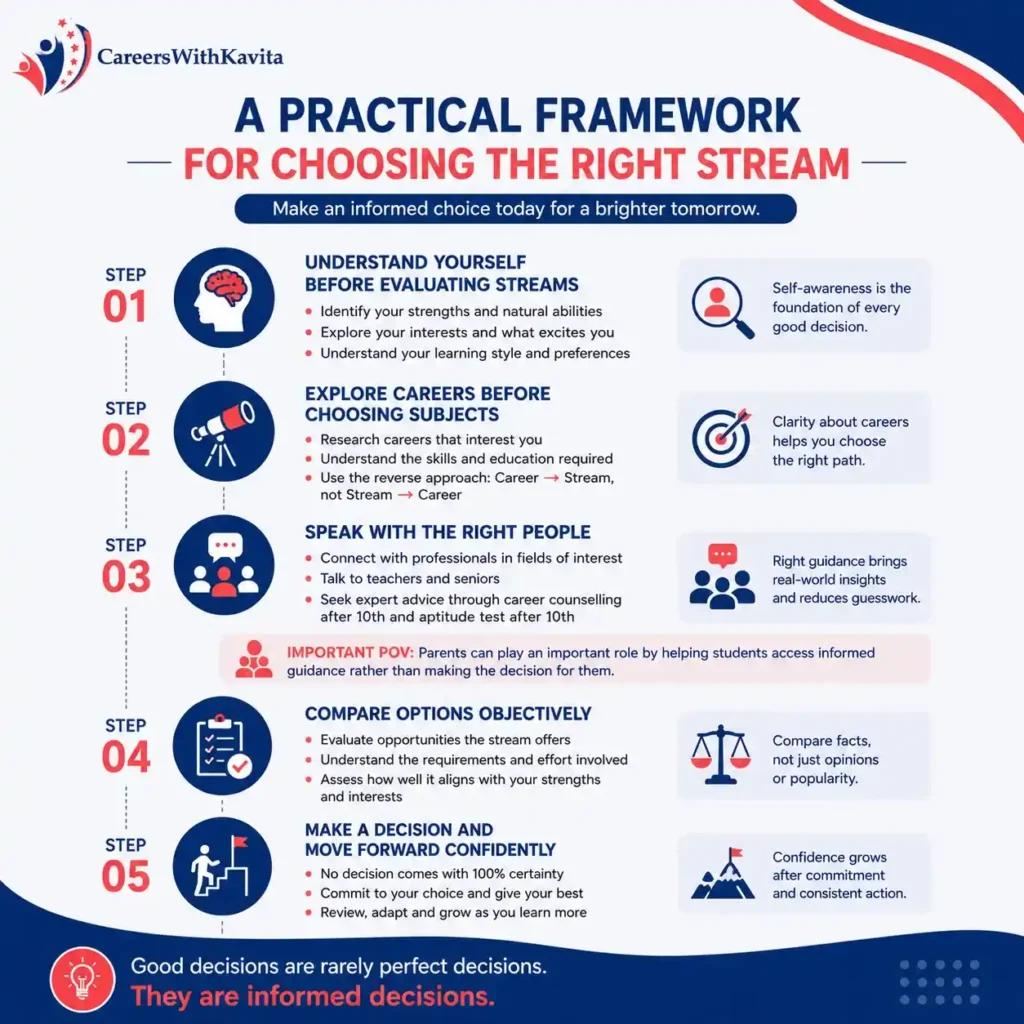
After understanding the available options, the next question is usually: which stream to choose after 10th? While there is no universal answer, there is a practical process that can help students make a more informed decision.
Step 1: Understand Yourself Before Evaluating Streams
Before comparing streams, take time to understand your own strengths, interests, and learning preferences. Think about the subjects you consistently enjoy, the activities you naturally gravitate toward, and the type of learning environment where you perform best.
The goal is not to find a perfect match but to identify patterns that can guide your decision.
Step 2: Explore Careers Before Choosing Subjects
Many students choose a stream first and then try to figure out what careers it can lead to. A more effective approach is to work backwards.
Start by exploring careers that genuinely interest you. Then research the educational paths required to reach them. In many cases, clarity improves when you think Career → Stream rather than Stream → Career.
Step 3: Speak with the Right People
Career decisions become easier when they are informed by real-world perspectives. Talk to teachers, professionals, seniors, and, when appropriate, qualified career counselors who have experience guiding students through similar decisions.
An aptitude test after 10th can also provide useful insights, but it should be viewed as one input rather than the final answer.
Parents can play an important role here. Instead of making the decision on behalf of their child, they can help facilitate meaningful conversations and access to reliable career counselling after 10th.
Step 4: Compare Options Objectively
Once you have shortlisted a few options, compare them based on three factors: opportunities, requirements, and personal fit.
Ask yourself:
- What careers does this pathway support?
- What skills and commitment does it require?
- Does it align with my interests and strengths?
Step 5: Make a Decision and Move Forward Confidently
No career decision comes with complete certainty. Waiting for perfect clarity often creates more confusion.
Good decisions are rarely perfect decisions. They are informed decisions. Once you have gathered information, reflected on your options, and sought the right guidance, commit to your choice and focus on making the most of it. Confidence usually develops after taking action, not before.
What Happens If You Choose the Wrong Path?
One of the biggest fears students have when making a stream decision is the possibility of getting it wrong. While that concern is understandable, it is important to remember that career journeys are rarely as linear as they appear.
Many students discover new interests, strengths, and opportunities as they progress through their education. As a result, it is not uncommon for people to adjust their direction, specialize in a different field, or even pursue careers that are not directly related to the stream they initially chose.
More importantly, the skills you develop along the way do not disappear. Critical thinking, communication, problem-solving, discipline, and subject knowledge often remain valuable across multiple career paths. This is one reason why future career planning should focus on building capabilities, not just selecting a stream.
That said, choosing a stream without proper thought can create unnecessary challenges later. The goal is not to assume that every decision can be easily reversed, but to understand that course corrections are possible when needed.
Many successful careers are built through learning, exploration, and adjustment rather than perfect planning from the beginning. The best approach is to make the most informed decision you can today, while remaining open to learning more about yourself and your options as you move forward.
In Essence
Choosing a career path after 10th is an important decision, but it is not a permanent one. The most common mistakes happen when students make choices based only on marks, social pressure, popularity, or trends rather than understanding themselves and their options.
A stronger approach is to balance interests, strengths, and future opportunities while seeking informed guidance when needed. The goal is not to predict your entire future today. It is to make the best possible decision with the information you have right now.
Career clarity rarely comes from guessing. It usually comes from understanding yourself, exploring different possibilities, and making thoughtful decisions one step at a time. Focus on taking the next right step, and allow your career journey to evolve as you learn and grow.